
The Critical Minerals Talent Gap: A Headcount Problem AND an Ecosystem Problem
The constraint isn't too much speed outrunning safety. It's not enough capacity to go as fast as the moment demands.

Right now, some of the biggest names in AI are publicly asking the industry to slow down. I'm not going to get into whether that's the right call, that's a different piece for a different day (go watch the original Terminator movie and you can figure out my perspective real fast). But in thinking about it for a sec, it's the exact opposite problem of what's happening in critical minerals and rare earths.
Nobody in this industry is asking anyone to slow down. If anything, it needs to move faster than it currently can. The constraint isn't too much speed outrunning safety. It's not enough capacity to go as fast as the moment demands. Billions of dollars are moving into mining, separation, and magnet manufacturing across the US and its allies. Less discussed, but just as real, is the constraint sitting underneath the capital: there aren't enough people who actually know how to run this equipment at scale. That gap is real. What isn't settled is what closes it, or how fast.
The easy conclusion, the one I keep seeing, is that this kind of technical expertise takes a generation to build, because that's roughly how long China took to build theirs. I don't buy that framing. I've lived a version of the counter-argument twice, once at a scale most people can picture, and once at a scale most people lived through without realizing what they were watching.
The small version: at ChargeLab, I took the operations function from two people to thirteen inside a category, EV charging infrastructure, that barely had an established playbook yet. Nobody I hired walked in with five years of "EV charging operations" on their resume, because that job hadn't existed for five years. What we hired for was adjacent skill and the ability to learn fast, and what made those hires productive wasn't a degree. It was whether we'd actually built a system to get them up to speed: documented process, direct mentorship, someone senior accountable for someone junior's ramp, not just hoping it happened in the company Slack channels.
The bigger version I watched from inside Apple's own production organization. China didn't become the world's manufacturing center because it graduated the most engineers. It became the center because companies like Apple showed up, invested directly in the factories, the training, the supply base, and stayed for twenty-plus years while that investment compounded. Every production run taught the workforce something. Every new product taught the supply base something. What started as basic assembly work turned into one of the most sophisticated manufacturing ecosystems on the planet, not only because China outspent everyone on schools (they really did), but also because a set of companies committed to building a durable, trusted production system there and kept reinvesting in it year after year. That's the actual model. Not headcount. Ecosystem, compounded over time.
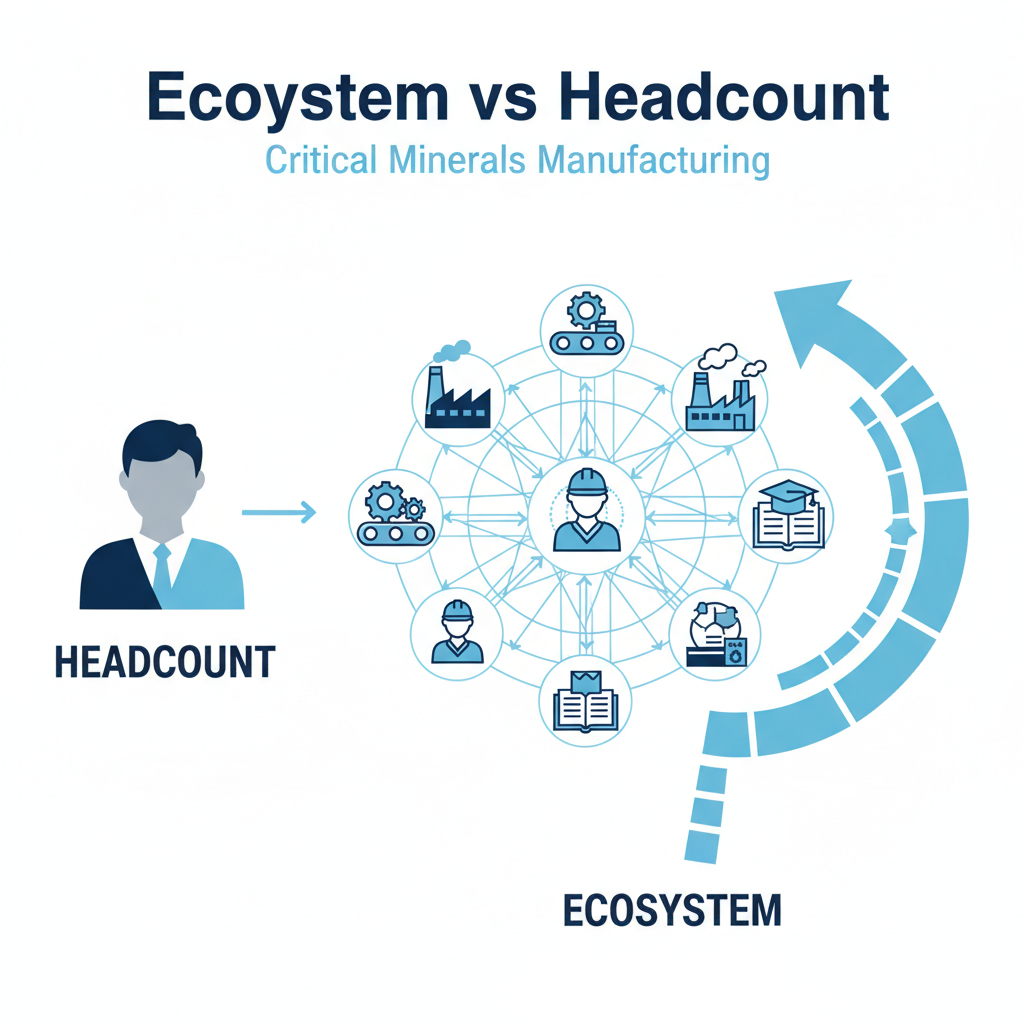
That's the frame I think the critical minerals conversation is missing. Do we need to produce many more mining engineering graduates in the US? Absolutely. What we really need to understand is whether the US and its allies are willing to build the same kind of compounding, trusted ecosystem in critical minerals that Apple and others built in Chinese electronics manufacturing, just pointed at a different set of materials and a different set of countries.
Another semi-hidden gap: where the minerals actually are
China's other advantage isn't just domestic. It spent decades building relationships in mineral-rich regions, Africa especially, largely through Belt and Road financing. But look closely at what that model actually did in-region: it locked up access to the ore, and then shipped almost all of the value-add, the separation, the refining, the actual profitable part of the chain, back to China. The mining country got extraction jobs and infrastructure loans. China got the margin.
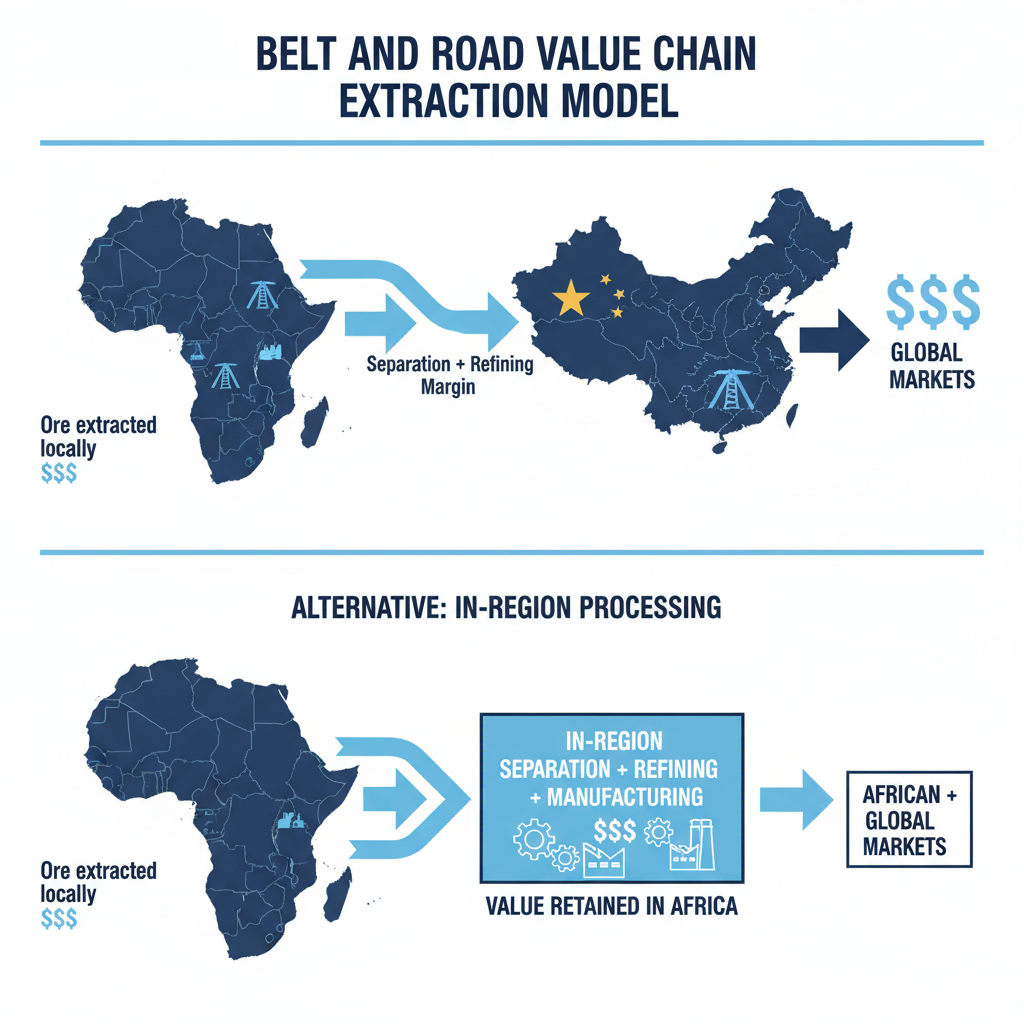
That's the opening for everyone else. If the US, Europe, and allied capital actually want to compete, the play isn't to copy the extraction-only version of that deal. It's to build in-region value creation: processing and separation capacity located closer to where the ore comes out of the ground, so mineral-rich countries capture more of the value chain and have a real incentive to partner with someone other than Beijing. There's already real movement in this direction, corridor and infrastructure investment tying mines in Central Africa to ports designed for allied offtake instead of Chinese-bound rail, and that's the right instinct. It needs to happen faster and at more nodes in the chain, not just at the mine mouth.
Alongside that, founders and capital allocators need to get disciplined about sequencing. You don't need to stand up the entire mine-to-magnet chain domestically on day one. You need to identify which specific links in that chain can be stood up the fastest, separation capacity is a very different build than a new mine, and place them where the supporting infrastructure and workforce already exist, rather than trying to build every stage everywhere at once. Speed to a working link matters more right now than completeness of the whole chain.
The workforce is already out there. It's just not labeled "rare earths"
Here's the part I actually know something about firsthand. A lot of what's being figured out right now in lithium processing looks a lot like what's already being done in battery energy storage systems, which is where I spend my days. Old, deep, mature process technology, chemical separation, thermal processing, materials handling that's been refined for decades, is getting a second life by putting modern AI, machine learning, and control algorithms on top of it. Same base equipment, same underlying chemistry, but a meaningfully higher rate of return on the same time and capital because the software layer is doing what a much larger, much more experienced human workforce used to have to do by feel.
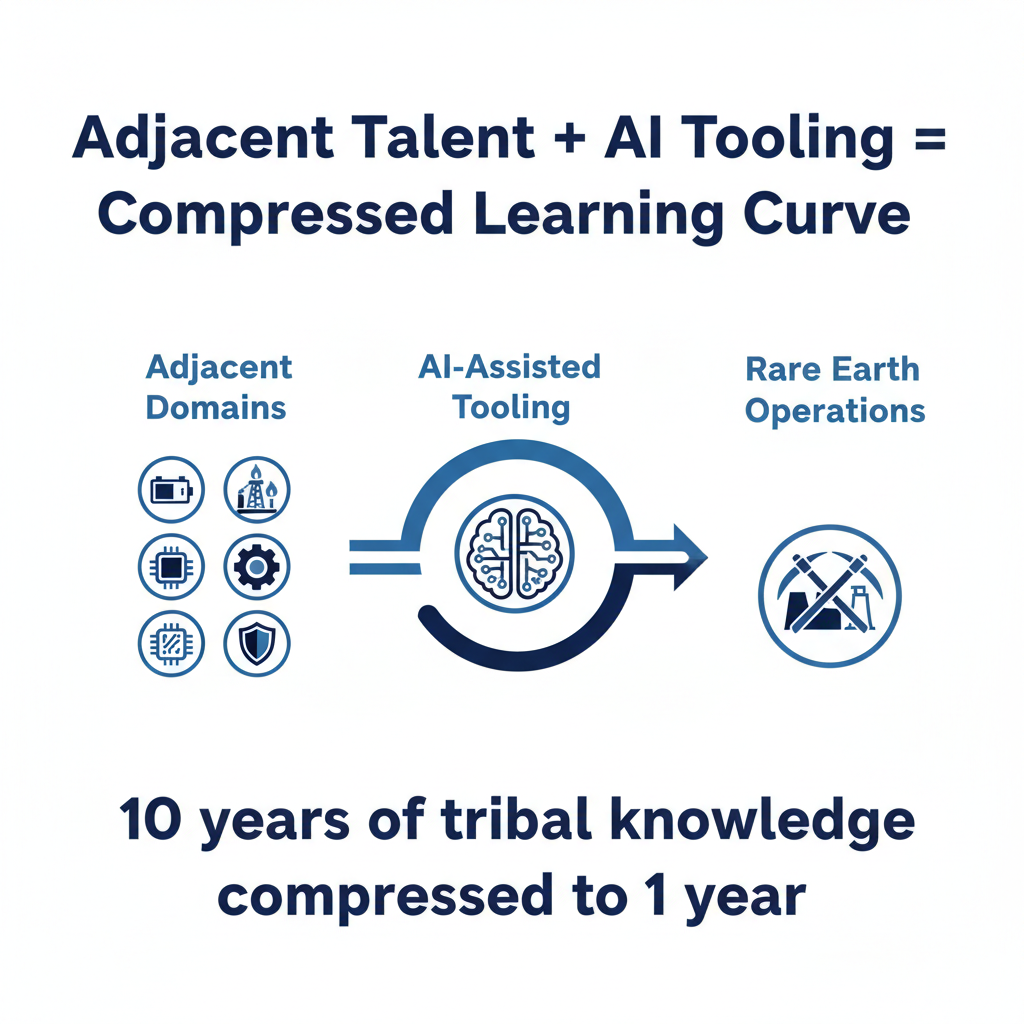
That's the actual talent play. Instead of waiting for a domestic pipeline of credentialed rare earth engineers that doesn't exist yet, go find the people who already understand adjacent hard-tech domains, battery chemistry, oil and gas process engineering, defense manufacturing, semiconductor fabrication, and port them over. Pair them with the AI-assisted tooling that shortens the learning curve, and you've compressed a decade of tribal knowledge into something closer to a year.
What actually has to happen, and who has to do it
For entrepreneurs and founders
- Treat knowledge transfer like a product from day one: documented SOPs, paired mentorship, a named owner for every new hire's ramp.
- Recruit for adjacent expertise on purpose rather than waiting for a "rare earths" resume that mostly doesn't exist yet.
- Sequence your build around the fastest link in the chain you can stand up credibly, not the most complete one.
- Where you're sourcing ore internationally, build the in-region processing partnership instead of the extraction-only deal.
For government and institutions
- University grants matter, but they're the slowest lever. The faster levers are direct funding for apprenticeships tied to actual production lines.
- Fast-track credential recognition for allied-country experts in adjacent fields so capacity gaps get backfilled now instead of in five years.
- Back the corridor and port infrastructure that lets mineral-rich partner countries process in-region.
- Treat this as one coordinated industrial policy problem across agencies, not a pile of disconnected grants and loans.
None of this takes a generation. It takes someone deciding to own the transfer, on purpose, starting now.