
Mined Is Not Refined: Why the Rare Earth Headlines Miss the Point
There's a lot of talk right now about critical and rare earth minerals. A framework deal for mineral rights in Greenland. China tightening export controls hard enough this summer that it directly hit MP Materials, the one company most people would point to as America's best shot at rare earth independence. Headline after headline, and almost all of them rush to the same place: who has the reserves.
I've seen better coverage on my nephew's pee wee football receiver corps. The real story is refining.
And it's not a niche story. It's not just EV motors and wind turbines, I've written about that side of it before. Rare earth magnets are in the vibration motor that buzzes your phone and the tiny speaker that plays your music. If you own a smartphone, you are already in possession of rare earth magnets, you just never had a reason to think about how they got there.
Here's how they get there, and why "how" is the entire ballgame.
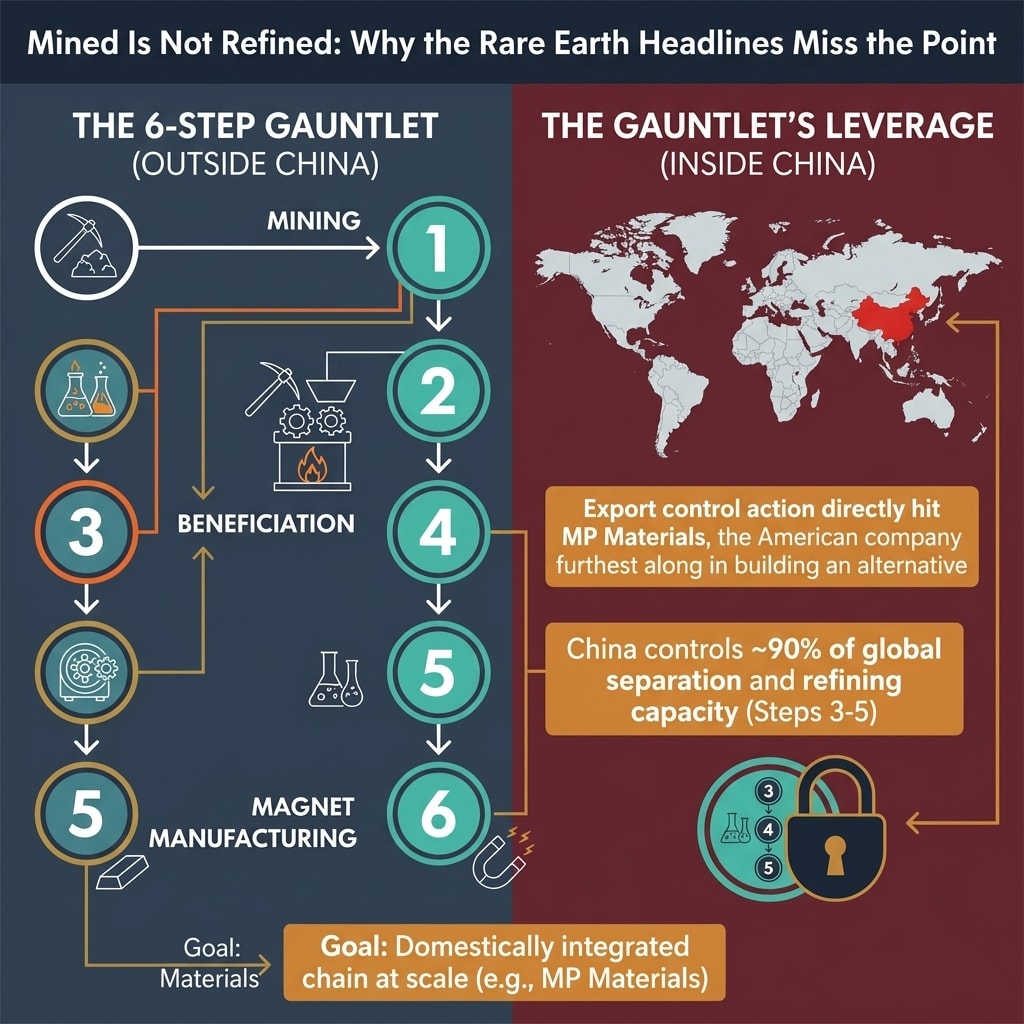
The six-step gauntlet.
Take Apple and MP Materials, because it's the most concrete version of this story running right now. MP Materials mines the ore at Mountain Pass, California, the oldest and largest rare earth deposit in the U.S. A good deposit like that runs somewhere around 4-7% rare earth oxide by weight. Everything else is waste. Step two is beneficiation, crushing and flotation, to concentrate that up to somewhere around 50-60%. Still not usable.
Step three is cracking: roasting the concentrate with sulfuric acid, then leaching it with hydrochloric acid, to get the rare earths into solution as chlorides. Now you've got a liquid soup of fifteen-plus elements that are chemically almost identical to each other. Neodymium and praseodymium sit next to each other on the periodic table for a reason, they behave almost the same way, and that's exactly what makes step four brutal.
Step four is solvent extraction. Separating rare earths from each other doesn't happen in a few passes, it takes hundreds of extraction, scrubbing, and stripping stages to fractionate that soup into individual elements at better than 99 percent purity. MP Materials has spent years building this capability domestically at Mountain Pass specifically so that concentrate doesn't have to ship to China for this step, and that alone is a meaningful chunk of why they're the company most people point to when they talk about American rare earth independence.
Step five is turning purified oxide into metal, NdPr through molten salt electrolysis, dysprosium through vacuum distillation, both to 99.99 percent purity or better. Step six is alloying that metal into NdFeB strip and manufacturing an actual magnet.
The bet Apple and GM are actually making.
That last step is what Apple just put $500 million behind. MP Materials is building a magnet manufacturing facility outside Fort Worth, Texas, and the deal is for Apple to source magnets made entirely from recycled rare earth material for hundreds of millions of its devices, the Taptic Engine that buzzes when you get a text, the speaker that plays your music. Shipments are targeted to start in 2027 as the plant ramps toward full operation. GM has a similar long-term deal with MP Materials for magnets in its Ultium EV platform. Two of the biggest OEMs in the world, betting real money that this six-step chain can actually get built outside China at scale.
Here's the kicker.
China still controls somewhere around 90 percent of global separation and refining capacity. Not reserves. Refining. And the export control action that hit MP Materials directly this summer is the proof of how much leverage that still buys them, even against the one American company furthest along in building an alternative. You can have the mine. You can even have a Fortune 500 company writing you a nine-figure check. Getting through steps three, four, and five at scale is still the hard part, and it's still mostly happening in one country.
Let's think about the gold I pulled out of a factory in China when I still worked inside Apple's own supply chain. That was one element, already refined, sitting in a warehouse, and it still took me months to build a process from scratch because nothing existed yet. Now Apple's betting nine figures that a much harder version of that problem, six sequential steps, hundreds of extraction stages, chemically identical elements that don't want to be separated, can get built out at scale by 2027. That's the actual size of the bet everyone's making right now, and it's not the bet the headlines are covering.
The question worth asking.
So when you read the next "critical minerals deal" announcement, the question worth asking isn't where the mine is. It's whether anyone's actually building separation and refining capacity behind it, because that's the six-step gauntlet between a rock and the phone in your pocket, and right now almost all of it still runs through one country.
I keep a running reference on the elements that show up in this kind of story, spot price, supply chain facts, why each one matters operationally. If you want the fuller picture on NdPr, dysprosium, and the rest, it's on the Element Guide.
Related reading
The gold recovery story that started this series:
Finding the Pot of Gold (Inside a Chinese Factory) →If I Had to Get That Gold Out of China Today →Want to talk through what supply chain complexity means for your operations?
I work with operators who want the honest version of this conversation, not the pitch deck version.
Let's Talk