
Previously I told y'all the story of getting Apple's leftover gold out of a factory in southern China. 2015 watch, discontinued in 2016, a pile of unused 18-karat gold nobody had a plan for, and a VP of Finance who wanted the cash back badly enough that to this day, whenever I think about this project an image of the Lucky Charms logo immediately pops into my head.
I built that entire reverse logistics process by hand. Accounting framework, cross-functional coordination with finance and the contract manufacturer, physical-and-financial reconciliation across multiple storage sites, and a pricing negotiation that came down to assay purity and payable percentage against spot. Months of work, most of it me chasing people down hallways and rebuilding spreadsheets from scratch because nothing existed yet.
That was ten years ago. So how about we look at this same problem through 2026 tooling and be honest about where we might gain some efficiencies and where we in the business world are still stuck in 2016.
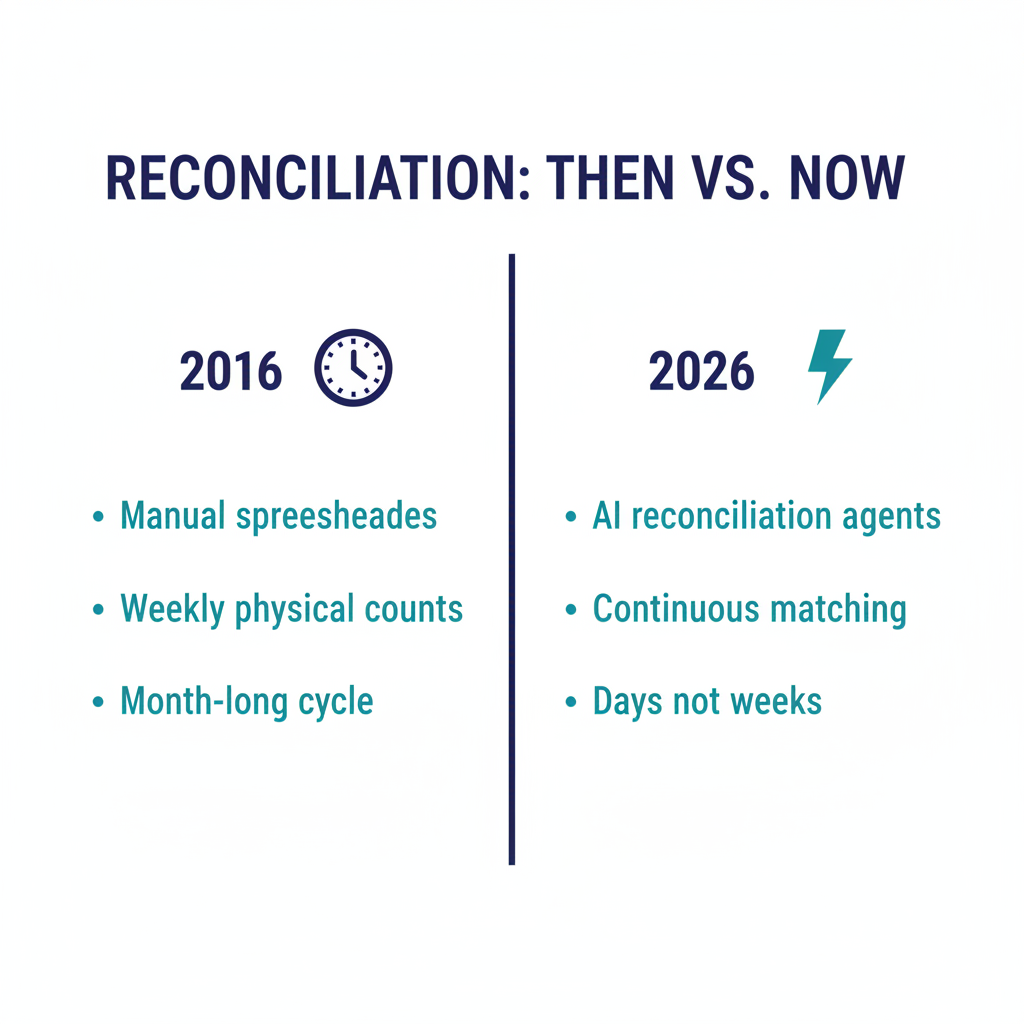
Reconciliation is the easiest win.
The slowest part of that project wasn't the negotiation, it was proving the gold was where we said it was. Multiple storage locations, physical counts against financial ledgers, chasing down discrepancies by hand. Gartner's projecting AI-enabled close processes cutting reconciliation cycles by close to a third by 2028, and finance teams already running AI reconciliation agents are reporting close cycles dropping from seven days to three. That's not hype, that's a real agent matching physical counts to system records continuously instead of me and a spreadsheet doing it once a week. If I ran this project today, the reconciliation phase that ate a month of my time gets compressed to days. This by the way assumes that the data is reliable and in good shape. If not, that's a story for another day.
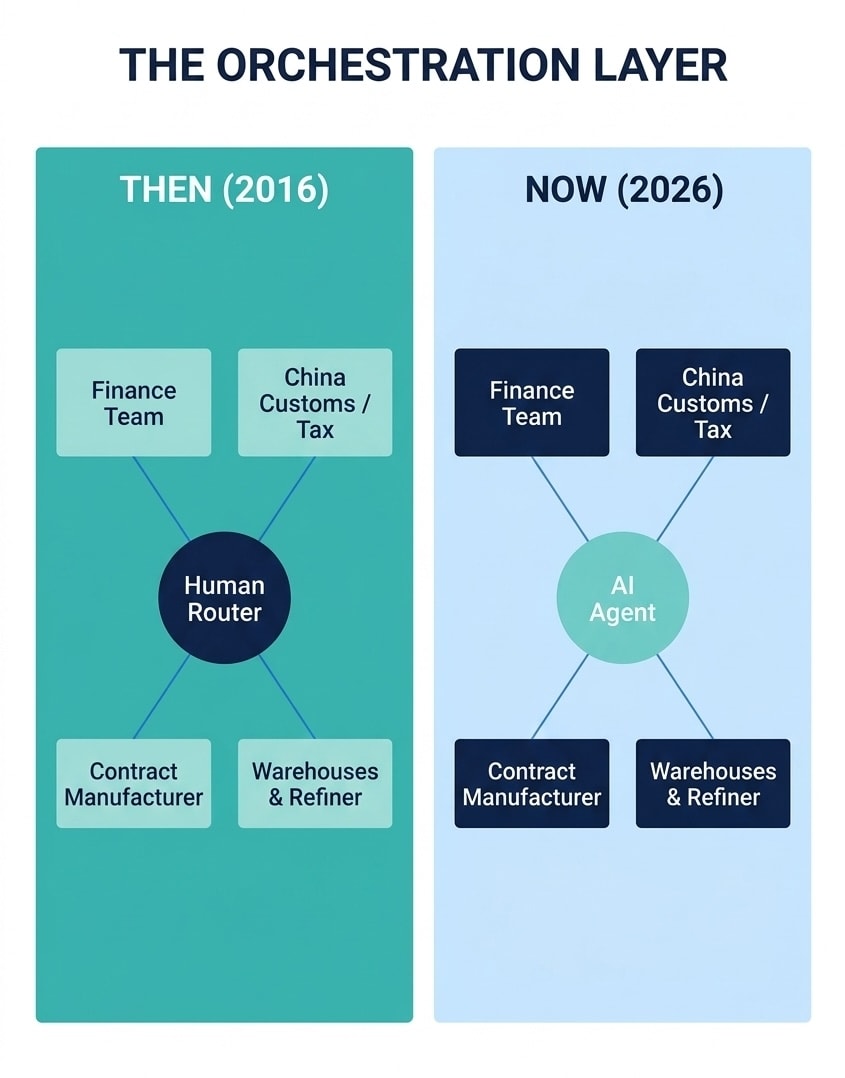
Cross-functional workflow is the second win.
This is the one most operators need to focus on. Half of my job on that project was just being the human router between finance, the contract manufacturer, and other various factions of external entities (China Customs, Tax, Warehouses and the refiner). Somebody had to know who owned what, chase status, and keep four workstreams moving in the same direction. Atlassian's Rovo agents in Jira reached general availability this year, and they can now be assigned actual work, not just tickets, referencing the Teamwork Graph to understand what a task depends on and who needs to weigh in. That's the difference between a ticket sitting in someone's queue and an agent actually triaging it, routing it, and flagging the blocker before it becomes a week-long delay. I was the orchestration layer on that project. Today, an agent could be.
Compliance monitoring is the third.
And it's the one I'd trust the least without a human checking its work. Getting precious metal across a Chinese border wasn't about a single rule, it was about knowing which rules applied and staying current as they shifted. AI classification tools doing HS code assignment and anomaly scoring are legitimately good now, and customs agencies are running the same kind of scoring on the other side of the table to catch the exact things you'd want to catch on yours. Eighty percent of trade professionals are already using AI tools weekly for exactly this. That's real. What I wouldn't do is let an agent make the final call on a gray-area compliance question with real legal exposure. That's still a person's job.
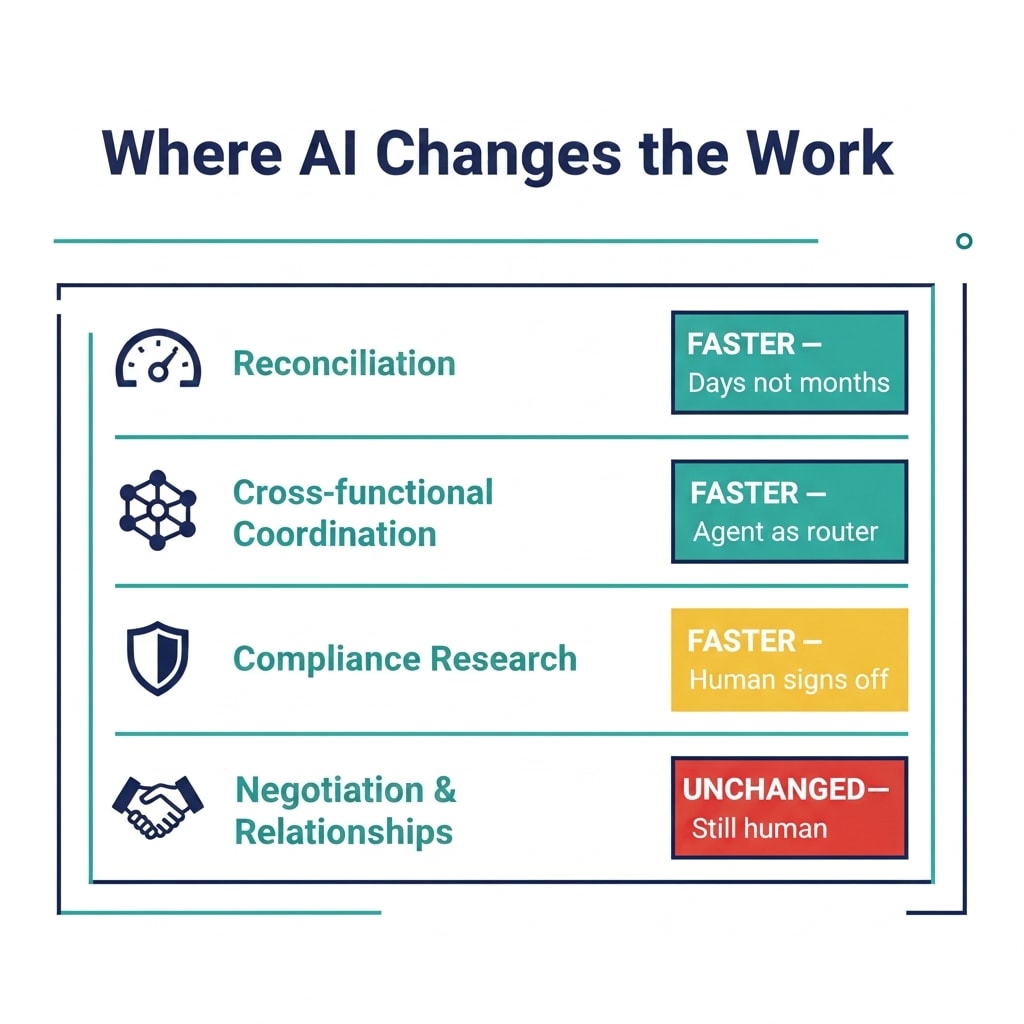
Here's where I'd keep a human, full stop.
The actual negotiation. My top two negotiation rules used to be, do your homework and never negotiate over email. With AI, we now have to make some rules adjustments. Assay purity, payable percentage, spot pricing, that's math an agent can model faster than I ever could. But sitting across from a refiner and knowing when they're posturing versus when they're at their real number, that's not a modeling problem. And managing a VP of Finance (not to mention Ops Procurement leadership) who wants the company's money back and wants to feel like someone competent is on it? No agent's doing that. AI shortens the plumbing. It doesn't replace the judgment call, and it definitely doesn't replace the relationship.
The honest read.
So if you handed me this exact problem today: reconciliation goes from a month to days, cross-functional coordination goes from me playing human router (DRI extraordinaire, if you will) to an agent doing first-pass triage, and compliance research goes from manually piecing together which rules applied to a system flagging it in real time with me signing off. The parts of the job that were mechanical get fast. The parts that were judgment stay exactly as hard as they were in 2016.
That's the honest read on where AI actually changes operations right now. Not everywhere, not magically, but in the specific places where the bottleneck was volume and speed instead of judgment.
If you haven't read the original story, it's on Substack. Link in bio, or find it at Finding the Pot of Gold (Inside a Chinese Factory).
Want to talk through what AI actually changes in your operations?
I work with operators who want the honest version of this conversation, not the pitch deck version.
Let's Talk