

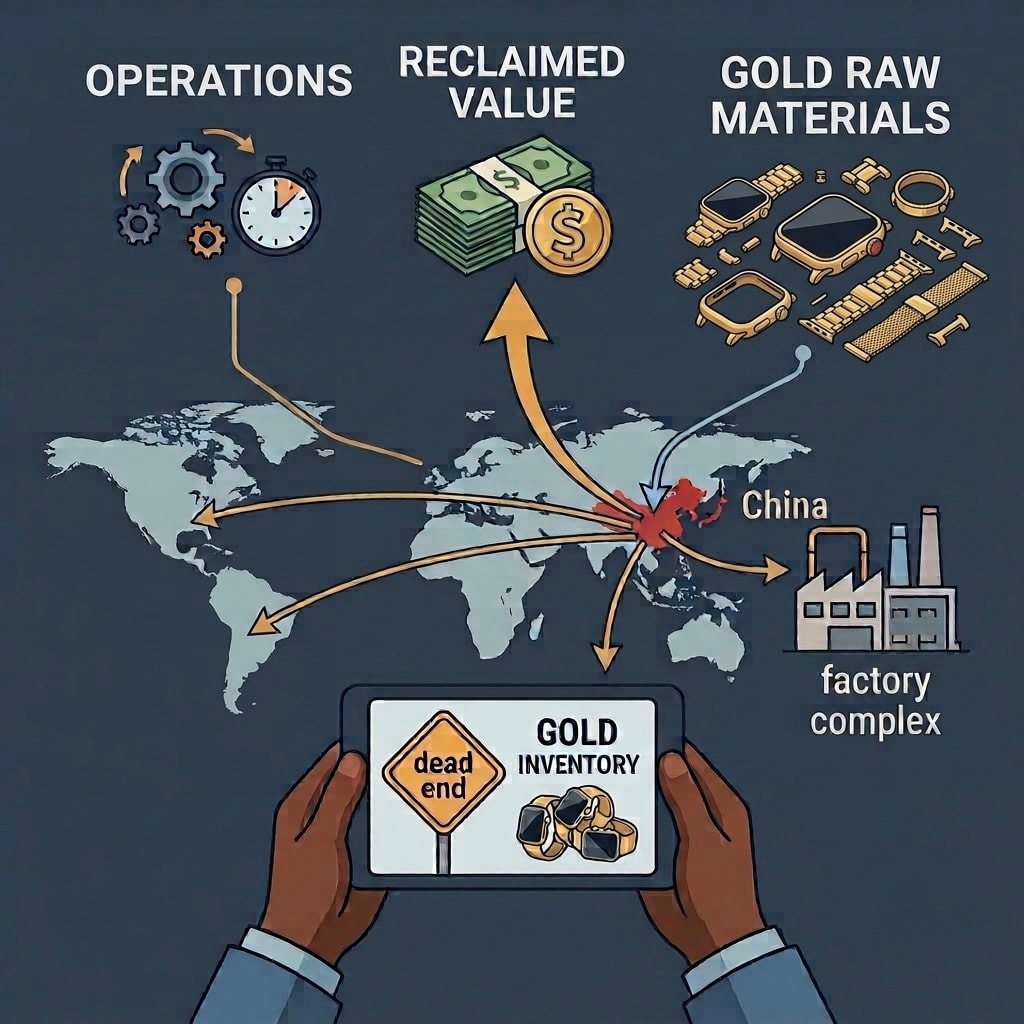
Nothing like the combination of Southern China and the middle of August; I was drenched in sweat from walking between factory buildings in the kind of heat that makes you feel like you're standing too close to the mouth of a feverish dragon. That walk ended in a storage room inside a factory complex in China, standing next to a modest but very real stash of gold casings, buttons and watch bands that Apple simply could not touch. I had a phone, a laptop, and, at most, concepts of a plan. I wish I could say that I made this up, but it's the actual starting point of this story.
Let's rewind a little. In 2015, Apple launched the Apple Watch Edition in an 18-karat gold case, priced from $10,000 to $17,000 depending on the band. It was the strangest, boldest thing Apple did that decade, and it did not sell anywhere close to what the supply chain had been built for. When Apple Watch Series 2 shipped the following year, the gold edition quietly disappeared from the lineup.
Apple, in true Apple fashion, had been excellent at solving the front half of that supply chain. Getting a genuinely rare, heavily regulated raw material into a Chinese factory, refined, alloyed, and turned into a watch case, on schedule, at scale. It was as if no one had spent a minute thinking about the back half. What happens to the leftover gold sitting in the building once the product line is dead.
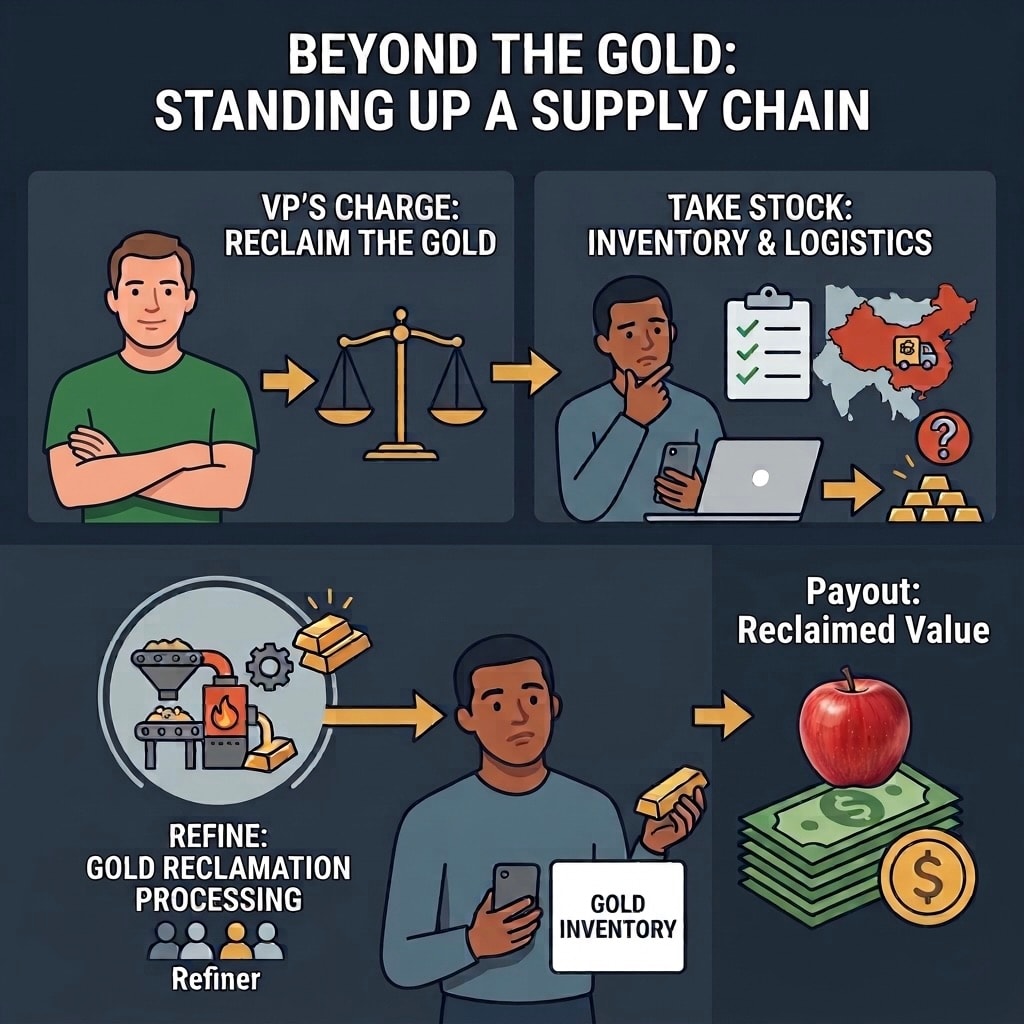
By the time Series 2 launched, there was a non-trivial amount of unused gold materials parked across a handful of storage locations inside that factory complex. And then the assignment showed up on my desk in the shape of one sentence from our VP of Finance, an Irishman who never once let anyone forget it: he wanted that money back.
That was the entire brief. There was no process behind it, because nobody had ever needed one.
For the next several months, every single time the VP passed me in the hallway, he'd ask, with a completely straight face, "where is the gold?" At some point, the team started to refer to him as a Leprechaun. This fit a little too well for a man asking me on the regular to conjure gold out of multiple factory buildings in southern China.
I get it. It seems like such a straightforward project. Herein lies the rub. A factory in China cannot just decide to ship gold out the front gate because a finance executive wants a pot of gold liquidated. The Chinese government keeps a very tight grip on what materials move into and out of a facility, and precious metals sit near the top of that list. Get that wrong and you are not looking at an accounting problem. You are looking at a legal one, for the factory, for the supplier, and for Apple. My actual job was never "get the gold out." It was "get the gold out in a way that survives a customs audit, a tax audit, and an internal audit, simultaneously, without anyone going to jail."
So I built the whole thing from a mostly blank page.
The framework first, then the people problem.
First, the framework. How does a reverse shipment of precious metal actually work from an accounting, tax, and transportation standpoint, in a country where none of those three questions have an easy answer even when you're moving something boring. Then the people problem, which turned out to be bigger than the paperwork problem: getting Apple's own finance and operations teams, the contract manufacturer, and the logistics providers who actually understood how material clears customs in the direction almost nobody ships it, all pointed at the same plan.
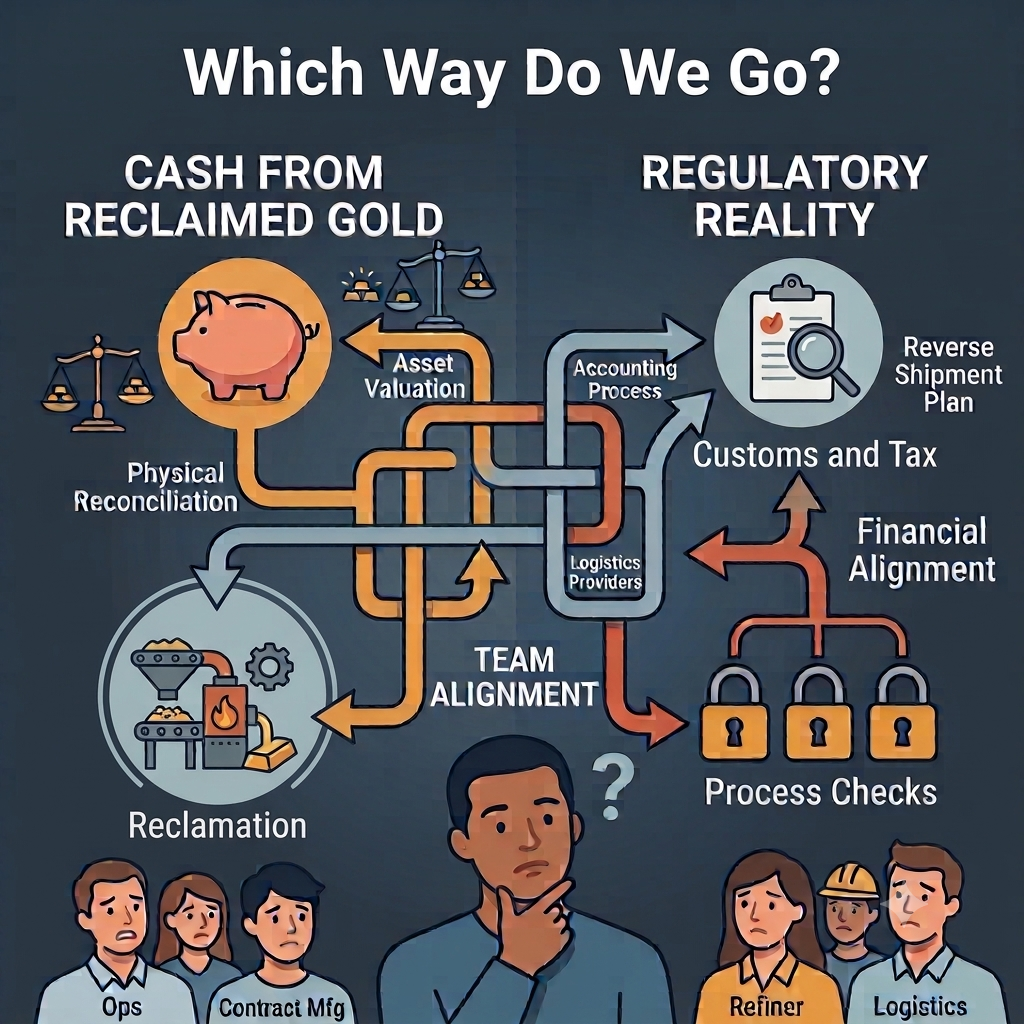
Then came the part that felt like performing alchemy in reverse. The gold was not sitting in one tidy vault with a number taped to the door. It was spread across multiple storage locations throughout the factory complex, accumulated over the life of a product line, handled by different teams at different times who had never been asked to track it as a single asset. Before a single gram could move, I had to physically account for every bit of it and reconcile that count against what the books claimed should be there. Not a spreadsheet exercise. Walking rooms, checking custody logs, and refusing to sign off until the physical pile and the financial ledger told the exact same story.
The lever that actually mattered.
Only after that reconciliation closed could I negotiate the part that actually mattered to our favorite Leprechaun, err VP: the pricing structure for the reclaimed gold. That fight had nothing to do with customs paperwork. It came down to the assay, the lab result certifying exactly how pure the gold actually was, and the payable percentage a refiner offers against that purity, priced off the day's spot rate. A point or two of difference on either number is real money at that volume, and that was the lever that actually mattered.
It took a few months, from start to finish. Every gram got accounted for. The gold moved, legally, cleanly, and the reclamation value came in above what Finance had originally asked for. I do not know if that made him a believer in the luck of the Irish. I know it made the Financial Review meetings a lot more pleasant.
What the gold was really about.
I think about that project a lot from my Apple years, and it's not really about the gold. It highlights a time that I truly understood, hands-on, that every physical product carries a raw material story that has nothing to do with the product itself. A watch case does not care that it used to be a bar of gold sitting on a shelf in a factory storage room. Somebody has to.
That is the same discipline sitting underneath everything I write about now: rare earths out of a mine in one country, refined in a second, assembled in a third, priced against a market that does not care about any of it. I did not discover critical minerals as a subject when it became a headline. I discovered it standing in a storage room in China with a phone and a laptop, counting gold, because an Irish VP wanted the company's pot of gold back and there was, at the time, no leprechaun available to produce one.
Well, until I showed up.
Have a Mess That Needs Sorting Out?
I fly in, open the bag, and build the process that didn't exist. Let's talk about what you're dealing with.
Book a Jerapy Session